

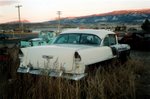


An interesting post came up in the forums on edmunds.com concerning gas prices. The poster was responding to an earlier comment from a Chicago area commuter who said he traveled at or slightly below the speed limit, mostly on 4-lane roads, on his drive to work. Others however drive like crazy only for him to catch up with them at the next red light -- the all-too-familiar "hurry up and wait" syndrome.
Here is the response to the commuter:
I'm not advocating that a person drive like a madman. I'm simply saying that if you drive at exactly the speed limit or a couple miles below on a road where traffic can't pass you then you are going to p___ people off. I've driven throughout most of this country and, for whatever reason, I've noticed that everywhere our speed limits are set artificially low. I've noticed that most people deal with this by driving around 6-9 mph over the limit, which is typically below what will put them at risk of a speeding ticket. Let's say the limit is 55 mph and you choose to drive 54 and have a bunch of people stacked up behind you that would otherwise be driving 63 mph. Would these people behind you really be saving all that much time? Probably not. Guess what, you're not saving all that much money [on gas].
My experience is the opposite of yours. I routinely drive a route that has a 12 mile stretch of road where it is almost impossible to pass. The posted limit is 50 mph but it is safe to travel considerably faster than that. Until a few years ago the predominant speed on this section of road was 60 mph, [but] it is now 50 mph. When you finally get to the end where there is room to pass you typically have 20+ drivers behind one guy that felt he was justified in imposing his will on everyone else.
I don't care if a person wants to drive slower to save a few bucks on gas. Just don't disrupt the flow of traffic.
I am especially amused by his saying, "for whatever reason, I've noticed that everywhere our speed limits are set artificially low." And my response would be, "in whose opinion?"
Well, I can tell you in Michigan that the speed limits aren't artificially low. Cars are allowed to go 70 mph on the metro Detroit freeways, and even major roads in the area with traffic lights like Telegraph Road have a 50 mph speed limit.
Most states west of the Mississippi have rural interstate speed limits of 75 mph for passenger vehicles. In Nevada, you can go 70 mph on the rural 2-lanes. On busy city streets in Los Angeles, the speed limit is 35. New Mexico allows 70 mph on undivided 4-lane US 550 (with conventional intersections even). The blanket speed limit in Manhattan is 30 mph. Certainly fast enough in all cases. I wonder if people driving on the parts of I-10 and I-20 in Texas that are now posted at 80 mph are complaining this speed limit is "artificially low" and bump it up to 86 to 89 mph.
If I'm "disrupting" someone's progress on a 2-lane road (one lane in each direction) by going the speed limit, my response is "too bad." However, I will encourage following drivers to pass me, if legal. If someone gets really obnoxious, like flashing his lights, flapping his arms, or getting so close I can't see his headlights, then I'll find a safe place to pull over. Or I wave them around in a legal passing zone. Funny thing, some of these people WON'T pass when you wave them around! Do they think I'm bluffing or somehow misleading them into a head-on crash?
Thursday, September 27, 2007
Speeding...or just going with the flow?


Monday, September 24, 2007
Running with the big dogs
 This photo was taken on I-275 southbound near Detroit. Lots of tractor-trailers were present on this highway on a weekday evening. The top speed limit in Michigan for cars is 70 mph, surprisingly allowed even on this roadway in the Detroit suburbs. Michigan however has a lower maximum speed limit for trucks: 60 mph. Ohio and Indiana also have split speed limits on their rural interstates. I like this idea: Even though the trucks generally do go faster than their speed limit, they generally do not travel at 70 mph, which makes it easier for cars to get around the trucks. Also on highways with 3 or more lanes in the same direction, trucks are not allowed in the far left lane. The situation pictured above was a little dicey, because there was essentially no left shoulder, but rather only a high Jersey barrier dividing the opposing roadways. Still, we got through with no difficulties.
Tuesday, September 18, 2007
Highway safety...1950s style!
 This billboard was spotted along US Route 250 near Dennison in the eastern part of
The Haddon Matrix considers all factors before, during, and after a crash: human (the driver, cyclist, or pedestrian), vehicular, and environmental (the road and roadside). For example, daytime running lights added to a vehicle can make it more visible before a potential crash, reducing the possibility of a crash with another vehicle in the first place. During a crash, built-in safety features in the car such as airbags can greatly reduce the possibility of death or injury. And prompt response by trained paramedics after the crash can further improve the chances of survival and recovery. Today, we practice this much more balanced approach to highway safety. Sadly however, not all measures that we know to be effective, such as mandatory motorcycle helmet use laws, are in place because of political pressure.
Friday, September 7, 2007
Monster trucks...Michigan style!
 Michigan
Tuesday, September 4, 2007
Portrait of an inconsiderate driver
 You can't see his face, but here he is, southbound on I-75 just south of
As you can see, he's driving a rusty old Toyota Corolla, not wearing a seat belt (typical), and holding the top of the steering wheel with one hand. Also, his seat back is so reclined that the head restraint would do no good in a rear-end crash. I guess he's going so fast though it's unlikely he'd be rear-ended at this point!
In case you are wondering, my wife took the photo from the passenger seat. And no, I wasn't holding up the traffic flow by going the speed limit. Large trucks in Ohio are limited to 55 mph on most Interstates. They may not go 55, but they do keep it under 65, the speed limit for cars. Most cars weren't going much faster than about 70 mph that evening.
Wednesday, August 22, 2007
Median crossover crashes a problem in Kansas
 I noticed a small news story in USA Today about a recent spate of deadly crossover crashes in
I've noticed that even on many Interstate highways that the typical grass median is not wide enough, in my view. For example,
Some states including the
Locally, there is one older freeway that raises eyebrows for me. It has a rather narrow level grassy median for most of its length, but on one half-mile segment that passes beneath a highway bridge and a railroad bridge, the median narrows down to a cement curb only about two feet wide. In this day of Jersey barriers (the ubiquitous curved concrete dividers where there is no space for a proper median), I am surprised that the state of
Wednesday, August 15, 2007
They don't build them like this anymore! #3
 This 1950 Dodge Coronet sedan was found behind a restaurant in the small town of Nellysford, Virginia. The Coronet was the top-of-the-line model, and this particular car had a "Gyro-Matic" automatic transmission. There is a badge on the front fender with this name. Most early automatic transmissions had catchy names like this, and they took America by storm in the 1950s. This car looks decent on the outside, but the interior was in very rough condition. Still, it's nice to look at with all the real chrome-plated metal adorning the exterior, quite unlike the "plastichrome" today's cars use.
Wednesday, August 8, 2007
Car dealer slang...not always nice!
These are some of the terms used by car salesmen (and maybe a few intrepid saleswomen), according to both a longtime poster and a newbie in the forums on Edmunds.com. (Thanks, "mackabee" and "greenpea68" for the list.) A lot of these words are not very complimentary to the putative customer; that's for sure.
in the box = finance office or business office
the tower = sales manager’s office
squirrels = customers with no loyalty to one salesperson
bumblebees = customers that can't decide between three or more cars
Disneyland shoppers = same as bumblebees
strokes = time-wasting shoppers
bogues = same as strokes
ghost = customer with no credit score
roach = customer with bad credit
a player = customer with strong credit
fairy = pipe smoking, folder carrying, internet customer
mooch = customer that wants floor mats, alloy wheels, satellite radio, etc, "thrown in," usually on a mini-deal
laydown = customer that walks in and pays sticker for a car
grape = same as laydown, as in "I stepped on a grape"
mini-deal = salespeople eating cheese sandwiches with no cheese (low-commission sale)
cherry = a very nice trade-in
rough = the opposite of cherry
sled = a beat-up trade-in (same as rough)
clam = same as a sled
skate = salesmen or women who steal customers from fellow salespeople; commonly known as thieves
snake = same as a skate
hand shaker = manual transmission
get me done = customer with terrible credit but can be financed, usually at very high interest rates
mop and glo = paint sealant and fabric protection
rust and dust = rust proofing and undercoating
delivery coordinator = woman with a big smile that sells mop and glo, rust and dust
"club them like a baby seal" = selling a car for full sticker!
grinder = “negotiates” for hours down to the last penny
pack = just another way for dealers to take money away from salespeople
front end gross = gross profit over invoice price less pack and shop fees
back end gross = gross profit in the box (finance or business office)
spiffs = daily or weekly bonuses for salespeople
stuff holders = storage bins
CSI = customer satisfaction index, inversely proportional to the amount of gross profit on the deal (that is, happy-go-lucky emotional buyers pay more; miserable analytical people pay less)
double nickels = $5500
pounder = $1000 front end gross: How many pounds was that? = a deal that has 2 or 3 thousand front end gross
home run = 4 pounder or $4000 or more front end gross
third base coach = someone at the negotiating table who is telling the buyer they don't have a good deal
spoon = a salesperson who gets a done deal from a manager
hook = same as a spoon but you might have to do some work
house mouse = a salesperson who gets all the spoons or hooks
veteran = a salesperson with more than 6 months at a store
greenpea = novice salesperson
rat = a trade that is a clam or a sled
$1 car = any trade that is worth $1000 or less; usually in real money only worth a dollar
team player = the only person who goes and gets coffee and lunch every day
"RUNNER !!!" = what is yelled when a customer gets up from the negotiating table and proceeds to walk out the door. The customer gets up and the salesperson says, "We got a RUNNER," one of my favorites...
Actually, I have found through reading Edmunds and the other car-buying sites that you ought to plan to be a RUNNER. That is, there is a plethora of information on the Internet (including detailed online dealer inventories) that should enable you to confidently walk into a dealership and offer YOUR price. Then if the salesperson comes back with a rejection from the sales manager, you head for the door. If you're not emotionally tied to the idea of buying a particular car from that dealership on that day, you are likely to have someone run out to intercept you accepting your offer!
Saturday, August 4, 2007
Joe Sherlock quotes Ann Coulter
I've stated before that I like Joe Sherlock's views on cars in his blog The View Through the Windshield, but I definitely don't agree with his politics. My respect for him has just dropped a couple of notches though with his recent salutory words for that hate-mongering self-absorbed far right-winger Ann Coulter.
As he puts it in his August 3 blog, "A Priceless Paragraph ... from Ann Coulter: 'CNN commentators keep telling us how young and hip the audience was for last week's YouTube Democratic debate, apparently unaware that the camera occasionally panned across the audience, which was the same oddball collection of teachers' union shills and welfare recipients you see at all Democratic gatherings. Noticeably, Gov. Bill Richardson got the first "woo" of the debate - the mating call of rotund liberal women - for demanding a federal mandate that would guarantee public schoolteachers a minimum salary of $40,000.' "
I'd never think of quoting Michael Moore or Al Sharpton for example, and I don't think either of these men has anywhere near the amount of venom to spew as the infamous Coulter. Responsible conservatives should have nothing to do with her. Shame on you Joe!
Thursday, August 2, 2007
Race car drivers: More skilled, fewer crashes on public roads?
The enthusiasts' call is unceasing, "If only we made driver licensing more stringent or trained drivers more thoroughly, we'd have fewer crashes." Well, I dug into some "archives" and unearthed an interesting study that relates directly to this issue. In the early 1970s the Insurance Institute for Highway Safety (IIHS) sought to compare the driving records of the general public with “national competition license” race drivers certified by the Sports Car Club of America (SCCA). The SCCA consented to participate because it was sure of the outcome: the “trained” drivers would certainly have superior records.
Surprise! Not only did the SCCA members have more traffic violations (well, not really a surprise), they had proportionately more crashes than the control group of drivers. This was true even when mileage driven by each group was taken into account.
Needless to say, the SCCA never again agreed to participate in further such studies. I’ll say it again: in driving, attitude trumps knowledge (that is, you can lead a horse to water, but you can't force him to drink). And of course, you have the overconfidence factor — the SUVs in the ditch scenario in that first winter snowstorm — but this too is part of attitude.
Friday, July 27, 2007
Scenic highways...in one's own back yard!


You don't have to go far for scenic views, at least where I live. These scenes were taken last spring, after a rare snowfall in April, after the trees had started to bloom and leaf out. The road, State Route 231, is a scenic byway in Virginia. This portion runs some 22 miles between the town of Madison in the county of the same name to its junction with US Route 522, just south of Sperryville, in Rappahannock County. The road parallels the Blue Ridge Mountains and features spectacular scenery any time of year, but especially in the fall, when the mountain sides become "flaming hills" from all the turning leaves, and in the spring, when the valleys and then the mountains begin to "green up."
Saturday, July 21, 2007
Karl gets a speeding ticket

I like Karl Brauer, the Editor-in-Chief of the popular edmunds.com website. However, the other day he was grousing on his blog about a speeding ticket he received on his daily 50-mile commute from
As Karl put it, "... it's been about 2.5 years since my last ticket, so I was due. Considering I drive approximately 30,000 miles a year (much of it on cop-addled Pacific Coast Highway) I don't feel a smidge of guilt at that rate of citation collection. And like nearly every speeding ticket I've ever received, this one had nothing to do with public safety. How do I know? Because...where I got the ticket -- a deserted stretch of road through flat, deserted farmland where you can see forever and there are no cross streets for a good 10 miles. The speed limit is 55, but Officer Williams says I was doing...(dramatic pause)...72.
"I didn't intend to do 72, but I was playing with the radio in our new Mini Cooper S, and the turbo engine (especially if you've hit the "Sport" button) has a habit of creeping up in rpm if you don't watch the speedo. I'm sure that in another 10 seconds or less I'd have scanned the gauges, seen my speed and eased back on the throttle. This is assuming that it was really me doing 72 mph. There were three cars in front of me, but when I pointed this out to the officer he insisted his radar could ferret out my speed from the others'.
"...Let me just clearly state that, in my opinion, 72 mph on that road, under those conditions, is still not unsafe in any way, shape or form. And if you think it is, then, also in my opinion, you're an idiot. The careless part was not using my radar detector to avoid a purely revenue-oriented speed trap.
"As I've said many times before, the concept of citing people for bad/dangerous driving doesn't bother me, but the concept of citing people for revenue generation does. The reason police patrol these areas isn't for public safety but because they know speeding is still a possibility. In much of
Ironically, I was speaking with a co-worker the same day Karl posted the above rant. The co-worker had recently lost her 95-year-old dad. She mentioned he always rued the one day in his long life that he was ticketed for speeding -- 2 or 3 mph over the posted 35 mph in a small town in his native
But 72 mph in a 55 mph zone on a 2-lane road? Inexcusable. In
Even in the tiniest VA towns, the speed limit often drops to 25 mph, yet within the Los Angeles city limits when I was there in December 2005, most speed limits seem to be 35 mph. On that trip, my wife and I flew out to meet our son and drove back east across the country. California allows 65 mph on US 395 (almost all 2-lane) once you leave the
We went north past Lone Pine to Bishop, and then headed northeast on US 6 to the
I haven't been in Ventura County north of
Karl brings up a point so often raised by enthusiasts. They claim speeding tickets are revenue generators, but police pay no attention to true examples of "bad/dangerous" driving, such as tailgating, weaving through traffic without signaling, and (the horror!) "camping" in the far left lane of multi-lane highways, blocking speeders' progress. As I have said much earlier on this blog, the go-fast crowd has pretty much convinced themselves that speeding, in and of itself, is harmless, and police should be concentrating their efforts on all these other lawbreakers! The irony is that the blatant speeders, who insist radar detectors are needed for their adventures, are in my experience also the ones who commit these other "bad" behaviors: tailgating, weaving, improper passing, and not giving slower drivers who happen to be in the left lane adequate time to move over to the right!
Monday, July 16, 2007
"Moskito Junction"

Pictured is a colorful row of Moskito mopeds for rent on the small resort island of Chincoteague, on Virginia's Eastern Shore. These are popular with the tourists, at least those who don't want to pedal a bicycle. Chincoteague and the nearby barrier island of Assateague, which fronts the Atlantic Ocean, are ideal places for bike or moped riding, because the terrain is flat (except for the short bridge connecting the two islands) and the top speed limits are 25 mph on the entire island of Chincoteague and 25-30 mph on the beach access road across Assateague.
The downside to the mopeds is that they are noisy like giant mosquitoes and their two-stroke engines emit smelly exhaust fumes, obviously more polluting than any modern passenger car or light truck.
Ironically, real mosquitoes are also ubiquitous on both islands. Chincoteague tries to keep the mosquitoes in check by frequent spraying from roving pickup trucks, but Assateague, being a national wildlife refuge and a national seashore, has no such control measures. It's best to wear repellent at dusk or stay on the beach where the wind is almost always sufficient to keep the pests at bay.
Thursday, July 12, 2007
Aloha! Hawaii reports record seat belt use

A recent article in the Honolulu Advertiser newspaper stated that seat belt use by front seat occupants had climbed to a record 97.6% in the Aloha State. This boggles my mind when I see so many people not using seat belts in central Virginia where I live. One important factor is that Hawaii has a so-called "primary" seat belt use law, where unbelted occupants can be cited directly by the police. Virginia by contrast has a so-called "secondary" law, where the car can be stopped only if some other violation, such as speeding, is first observed by a police officer.
Studies have shown that states with primary laws have greater belt use AND have fewer vehicle occupant deaths when population and other factors are taken into account. This is not surprising, because seat belts when used are very effective in saving lives in car crashes, and the unbelted tend to be the riskiest drivers and passengers. So getting these holdouts to wear belts brings the greatest benefits.
There is a rather interesting pattern as to whether a state has a primary or secondary law. Most of the coastal states (excluding New England) as well as the deep South, have primary laws. The plains and mountain states tend to have secondary laws, and the midwestern states are mixed. California, Oregon, Washington, and Hawaii all have use rates above 90%, the highest in the country. New Hampshire (the only state with no belt use law), the Dakotas, and West Virginia bring up the rear, with only about 50% belt use.
New England with its tradition of individualism has secondary belt use laws, except for Connecticut (primary) and of course New Hampshire (no law). Maine just recently adopted a primary law, slated to go into effect in September. Massachusetts and the upper New England states were among the last in the US to adopt mandatory belt use laws.
Thus, there isn't too much of a liberal vs. conservative pattern on seat belt laws with the "conservative" South having tougher laws than the "liberal" Northeast for example.
Sunday, July 8, 2007
George W. Bush: a failed president?
Before and shortly after George Bush took office, he repeatedly said that he would run an ethical, "adult" administration and restore dignity to the office of the presidency. He also said that he would not allow his administration to become involved in "nation building."
With regard to all of the above, he has failed.
Saturday, July 7, 2007
Madness...madness!
These are the closing words from the 1957 movie, The Bridge on the River Kwai. In the movie, the insanity of war was being described. Today we have another form of insanity: the horsepower war.
The enthusiast media are gushing over the latest product of this craziness: the 2008 Mercedes-Benz CL63 AMG, a high-performance model of the Mercedes' smallest sedan sold in the US, the C class. The CL63 follows the time-honored muscle car tradition of stuffing a large, powerful engine into a relatively small, light car. Only this engine is a 6.2-liter V8 pumping out 457 horsepower. According to this road test on edmunds.com, the car accelerates to 100 km/h (62 mph) in 4.5 seconds, has a governed top speed of 155 mph, but can reach 174 mph if an optional Sport package is ordered.
In contrast, the Hemi V8 in the Chrysler 300C sedan and Dodge Ram pickup is sized at 5.7 liters and makes 335 hp in both vehicles. The new large V8 in the Toyota Tundra pickup is also 5.7 liters and makes 381 hp. However, the 300C weighs 4046 lbs, while 2wd quad or double cab versions of the Ram and Tundra weigh about 5200 lbs. I was unable to find the curb weight of the new CL63, but the top-level 2007 C350 Sport weighs a relatively svelte 3,495 pounds with an automatic transmission.
Why we "need" such extreme power in a car today is beyond me. It's not just Mercedes that's engaged in this form of oneupmanship, but every car manufacturer is in the game. Still, the German luxury makers, including BMW, Audi, Mercedes, and Porsche, have taken it to a new level.
With oil prices now over $72 per barrel and gas cresting a few weeks ago at well over $3 per gallon in the US, one wonders just how long this "madness" will continue. After all, it is 2007, not 1967.
Wednesday, July 4, 2007

Lewis Libby and Independence Day
Got to be the second-worst awful moment of the presidency. Really makes me sick.
My list, in fact:
1. Mission Accomplished
2. Libby Pardon
3. "Out of the rubbles of Trent Lott's house -- he's lost his entire house -- there's going to be a fantastic house. And I'm looking forward to sitting on the porch" -- September 2, 2005, while blacks are trapped on rooftops in New Orleans.
4. Presidential Medals of Freedom awarded to Tenet, Franks, and Bremer
5. Reading "The Pet Goat" on Sept. 11, 2001
Iraq invasion doesn't make the list, on technicality. When is this nightmare over?
I responded:
I really can't believe he had the gall to pardon Libby, especially right now. This has really been a horrible presidency – worst since Harding? Certainly it is in my lifetime despite Nixon's shenanigans.
I'm sure you've seen the bumper stickers: “01-20-09 -- Bush's last day.” It can't come soon enough.
By the way, I like your list.
He then replied:
He did not pardon him--he commuted the jail sentence. It's worse--Libby can still plead the Fifth in further investigations and he now has no incentive to spill the beans about the CRIMINAL activities the White House has undertaken. Hopefully Bush, Cheney, and Rumsfeld will be prosecuted in the future, not just on war crimes charges.
I would say the worst president ever. No one, not even Nixon, has claimed such king-like powers. This is what our system is designed to prevent, the whole reason the founders did what they did--this is an abrogation of the principles of American freedom, pure and simple. There is nothing more contemptible.
Hang in there America, only 565 days left for the Bush presidency. Enjoy the 4th!
Saturday, June 30, 2007
A terrible way to die
Pulitzer-prize winning author David Halberstam was killed in a car crash in April in Menlo Park, California. He was being driven by a 26-year-old graduate student from the University of Berkeley when the student made a left turn in front of oncoming traffic. The older Toyota Camry the student was driving was struck on the right side of the passenger compartment where Mr. Halberstam, 73, was sitting. Halberstam died at the scene; the student suffered a punctured lung and the driver of the other car had only minor injuries.
Now the facts of the crash have been established. The crash occurred at the intersection of the Bayfront Expressway and Willow Road, just west of the Dumbarton Bridge across lower San Francisco Bay. The driver of the other car had a green light and was proceeding toward the bridge straight through the intersection. The graduate student, driving the opposite direction on the expressway, was facing two left turn lanes which had a red arrow, indicating of course that no left turn could legally be made at that moment. The student though was in the third lane from the left, a through lane coming from the bridge. Instead of going straight, however, the student made what possibly was a last-second left turn toward Willow Road, placing the Camry on a collision course with the oncoming late-model Infiniti, driven by a 64-year-old man.
From what I recall reading earlier, the graduate student had two prior driving convictions. He may have been a habitually careless driver, or perhaps he was so excited by the prospect of ferrying Mr. Halberstam that he wasn't paying enough attention to the driving task. Regardless, Mr. Halberstam had to pay a terrible price, and we as a society lost a gifted author who was still very much active. On the day of the crash, he was on his way to an interview for a book he was planning about the famous 1958 NFL championship football game between the New York Giants and Baltimore Colts.
There is a chance that the outcome might have been different if the Camry had been a 2002 or later model equipped with better side structure plus head- and chest-protecting side airbags. I have not seen photos of the damaged Camry to judge if such an outcome may have been possible.
The graduate student faces a charge of vehicular manslaughter, which carries a penalty of up to $1000 in fines and one year in jail. The Infiniti driver was not charged.
Friday, June 29, 2007
Chincoteaue Island, Virginia swing bridge

This photo shows the only bridge into the little resort island of Chincoteague on Virginia's Eastern
Chincoteague is famous for the wild ponies that have lived for centuries on the adjacent barrier
The decades-old swing bridge has deteriorated to the point that a new bridge into the island was proposed many years back by the Virginia Department of Transportation. The various proposals were quite controversial for island residents, so the VDOT was forced to go back to the drawing board. Finally, a new bridge is under construction a few blocks to the right of this photo and is scheduled for opening in the fall of 2009. It will also be a low-level bridge, so it will also have to be opened periodically to allow boats to pass through the channel. The new bridge will align directly with the main road across the island that links it to
Sunday, June 24, 2007
Noteworthy anniversary in auto safety today


According to the New York Times, " 'Today [June 24, 1983] was a very bad day for deregulators,' one lawyer insisted after the Supreme Court rejected the Reagan Administration's attempt to dump a 'passive' safety restraint rule for autos. It would be more accurate to say it was a bad day for regulators who ignore the will of Congress. The Court's stunning, unanimous ruling should signal a fresh start in the long-delayed effort to reduce traffic deaths with modern 'airbag' technology."
As we remember, Ronald Reagan was famous for his support of deregulation of big business and his distaste for what he called big government. Early in his administration, the US National Highway Traffic Safety Administration (NHTSA) repealed a planned regulation to require automakers to install "passive" restraints (airbags or so-called "automatic" seat belts). This rule was to phase in with the 1982 model year and be completed by the 1984 model year.
Insurance companies, led by State Farm and the National Association of Independent Insurers, sued the government, and the case went all the way to the Supreme Court. On this date in 1983, the court ruled 9-0 that the Reagan administration's repeal was "arbitrary and capricious" and that the auto industry had waged "the regulatory equivalent of war" on the airbag, a war the industry had "lost -- the inflatable restraint was proven sufficiently cost effective."
This decision paved the way for the Department of Transportation, led by Elizabeth Dole, to propose an ingenious new rule that had the salutary effect of prompting states to pass mandatory seat belt usage laws AND requiring the automakers to begin installing airbags or automatic seat belts in cars starting with the 1987 model year.
As we know, airbags won out ultimately over the automatic belts (some of which were poorly designed), and all cars and light trucks are now required to have driver and passenger frontal airbags. Seat belt use in the
Thursday, June 21, 2007
Limit the horsepower and top speeds of cars?
This interesting and courageous post was made by "xrunner2" in one of the http://www.edmunds.com/ forums on General Motors this past Monday:
“GM could take the lead in manufacturing and marketing sensible sized and powered cars and suvs. They could pronounce that they are doing their part to help US cut down on use and need for foreign oil by biasing future production of vehicles toward smaller, more efficient designs that need less fuel. They could also claim that they are doing their part as a responsible US company to help cut down on highway crashes (not accidents) by not putting high-powered or fast vehicles into the hands of immature drivers (which could be earth aged 16-80).
“Except for police cars they supply, they could even plan to build all of their vehicles say 5-10 years out that do not exceed 80 MPH and are totally tamper proof from those wanting to increase HP and or speed potential of vehicle. Can anybody justify the need or reason to go faster than 80 MPH? Can anybody justify having a car (3000-4000 lbs as example) with 300, 400, 500, 600 HP? Analogy of needing a 600 HP car is same as a whacko gun owner/collector claiming he needs a machine gun/gattling gun rather than a handgun only to protect his house and family from intruders.
“Now this would truly take great leadership. Does GM high management have the ability to take these steps? I believe that the vast majority of responsible driving Americans would agree with GM for making a commitment to sensible sized and powered vehicles. Other mfrs, Ford, Chrysler,
I'd have to say I agree with xrunner2. Why do we need cars with such high-speed capabilities when the highest speed limit in the US is 80 mph? Even on the fabled German autobahn, which has no posted speed limits on certain sections for passenger vehicles, the recommended speed limit is 130 km/h, or 81 mph.
Interestingly, the
Today, such a proposal still wouldn't get very far. But it makes so much sense in my opinion. I realize that making something truly "tamper proof" isn't possible. Still, a lot of high speed "flings" would be avoided with their attendant high risk for death and injury, AND carbon dioxide emissions would be lowered because fuel consumption rapidly increases at very high speeds.
Wednesday, June 20, 2007
Why do its detractors hate the Prius so much?

This is a recent example of what I'm talking about. I won't even "dignify" the author (if that's even the correct word) by providing his name.
“The millionth Prius was sold last week. A cross between a Mazda and a miscarriage - IT'S embraced by celebrities, environmentalists, and the nexus of evil: the celebrity environmentalist. Leonardo DiCaprio helms a hybrid hackeysack, allowing his conscience to remain clear while [having sex with] truckloads of broads who may or may not have been born before the Lillith [sic] Fair.”
The Toyota Prius has been vilified like this since the second generation model, introduced in the US as a 2004 model, was met with great success in the marketplace. It seems right-wingers like to emphasize Toyota's seeming "hypocrisy" in producing such a fuel-sipping car and projecting a "green" image while at the same time building a new assembly plant in Texas to crank out huge Tundra pickup trucks. Would they say the same thing if General Motors, for example, had produced such a car while simultaneously selling Silverados, Suburbans, and Hummers?
But the reality is that Toyota took a huge gamble on this car. It has paid off handsomely, especially in light of the recent spikes in gas prices. The car is simply the most fuel efficient vehicle sold in America, with EPA city/highway estimates of 48/45 mpg, under the "new" testing regimen for 2008 models.
Critics had pounced on the fact that few Prius drivers could attain the "old" city rating of 60 mpg. However, this was not the fault of the car, but rather the testing procedure which was developed long before gas-electric hybrid cars were on the drawing boards. These naysayers also liked to point out that the supposed extra initial cost of the Prius would take many years to recoup in fuel savings. This of course assumes that buyers would get a base model Corolla for thousands less and the price of gas will drop back to 2 bucks a gallon or so. Yet the Prius compares favorably with the larger Camry, as I'll explain below.
Prius haters also are fond of generalizing that Prius drivers buy the car in huge numbers because it alone has distinct styling among hybrid vehicles, and this allows the world to see how environmentally conscientious they are. Such balderdash!
My son and his wife bought a Prius one year ago as their first car. They were attracted by the fuel efficiency and the low emissions. Living in New York City, they are textbook examples of people who can make the most of the Prius's parsimonious fuel use. They also thought they'd get a huge federal tax credit of $3150, but this turned out to be a hoax due to the pernicious reach of the alternative minimum tax (a story for another day). Still they are quite pleased with the car, and they've been able to achieve average fuel economy in the 50+ mpg range. They are totally unconcerned with the image they project.
I can also state that the car has essentially as much headroom and legroom inside for 4 adults as our Camrys; the only dimension in which it is smaller is width, so 3 adults in back do not have as much hip or shoulder room. As a hatchback, the Prius actually has a larger cargo area than the Camry, and this is with the rear seats not folded down!
So let the ranters go on and on, while Toyota (and Prius owners) take their money to the bank and the rest of the automakers struggle to catch the leader!
Saturday, June 16, 2007
They don't build them like this anymore! #2

This 1957 Buick Special 2-door hardtop was spotted alongside US Route 13 in Nassawadox on the Eastern Shore of Virginia. "Nassawadox" means "the land between two waters" in Native American, because the Chesapeake Bay and Atlantic Ocean are only a few miles away in opposite directions.
The car appears to be in pretty good condition considering its age. It was under roof with a wire enclosure surrounding it. The Special was the base model Buick, but like all of its brandmates, it had a standard V8 engine. Note the unusual 3-section backlite, used on certain body styles of Buicks and Oldsmobiles in 1957-58. Another unusual styling feature for the time was the fully exposed rear wheel, when most cars had partially covered or even "skirted" rear wheels. This feature gives the car a look of power, even when standing still. Other Buick styling traditions include the swooping chrome "sweepspear" side molding and the "portholes" in the front fender. Most cars of this era had wraparound front windshields and optional wide whitewall tires.
Saturday, June 9, 2007
The (not so) good old days

As is well known, all of the former "Big 3" domestic automakers are in trouble currently, losing money in spades, and possibly heading toward bankruptcy. Although the present tailspin began very recently with the runup in gasoling prices and falling sales of traditional SUVs, it's common knowledge that legions of former domestic car buyers have switched their loyalties to the so-called "import" automakers, especially Toyota and Honda, over the last three decades. These companies as well as Nissan, Hyundai, Mercedes, BMW, Mazda, and Mitsubishi have assembly plants here in the United States. Many of these companies build their engines and transmissions here as well, and stamp the body sheet metal.
We're all familiar with horror stories regarding the Big 3's lack of quality and reliability. Most seem to think the downturn in these areas started in the 1970s. However, there were problems well before that; for example in their April 1965 annual auto issue, Consumers Union, the publisher of Consumer Reports, complained that their batch of mostly American cars selected for testing exhibited the poorest workmanship in a ten-year slide starting with the 1955 models.
In regard to build quality and reliability, we Americans tolerated a lot back in the 1960s before the imports could compete in the medium and large car field (unless you paid a king's ransom for a Mercedes, and even that was only "compact" size). This was before the often documented maladies of the 70s with the "Rube Goldberg" emissions controls that lowered gas mileage and made cars hard to start and keep running.
My mother's 1967 Chevy Bel Air 2-door sedan was rife with build quality issues, including numerous dents in the body work, a missing dome light bulb, and a driver door that scraped against the A-pillar trim when opened. There was also a "jingle bell" sound that some years later was discovered by my brother to be a loose bolt in the starter.
As for cheapness, granted we didn't have a mainstream Impala (pictured above in idealized splendor) or top-line Caprice, the trunk was totally devoid of any carpeting or trim -- all speckle-painted metal -- what was the point of the bottom of the line Biscayne?
I distinctly remember the automatic choke failing to shut off and the engine backfiring going up inclines within a couple of years of ownership. Rust started to bubble through the quarter panel behind the right rear wheel after just two Pittsburgh winters.
On a cross-country trip in 1971 (starting at 25,000 miles), the water pump failed on the way out and the alternator on the way back. Luckily back then, service stations still provided service; they weren't primarily gas, junk food, and cigarette outlets like today.
Detroit has mainly itself to blame for losing so many of its former loyalists. Let's hope the situation can be turned around, because competition is good for everyone.
Wednesday, June 6, 2007
Live free or die...right?
New Hampshire is the only state in the US without a mandatory seat belt use law for adults riding in the front seats of cars. It's been the sole holdout for more than a decade. Even "macho" states like Texas, Wyoming, and Montana long have had mandatory belt use laws. Yet New Hampshire persists; after all the state motto "live free or die" appears on every NH license plate. Does this mean "live free" of belt use only to die by being ejected in a car crash?
For the first time since the 1800s, the Democrats took control of the state legislature after the elections of 2006. The New Hampshire House of Representatives narrowly passed a bill in April to require belt use. However, the bill was defeated by the Senate last week, failing on a vote of 16-8. Instead, the senators voted in favor of a measure to establish a "study commission" to consider ways to get more people to buckle up.
This seems a little silly in light of well-documented research that shows persuasion alone, such as "education" through public service ads, is ineffective in raising seat belt use. No, it seems the threat of a ticket by breaking the law is the most effective method, provided enforcement is well publicized and highly visible.
One enlightened senator, Democrat Peter Burling, countered the "nanny state" or "big brother" arguments against mandatory belt use by citing another important New Hampshire tradition -- that of the self-reliant community dealing with its own emergencies. He recalled a recent car crash in his district, "The social compact that binds us together kicked into gear," describing volunteers coming from all parts of the town to help. "You don't [buckle up], you're telling every one of those people, 'I don't care how much it hurts you to see me spattered across the road -- it's my individual liberty. And your job is to fix it.' "
I couldn't have said it better myself.
Wednesday, May 30, 2007
Deaths on US highways down ever so slightly in 2006
According to a press release issued by the US Department of Transportation last Friday, Secretary Mary E. Peters said that traffic deaths on
While the number of road deaths is projected to have declined slightly nationwide from 43,443 in 2005 to 43,300 in 2006, “even one death is too many,” Secretary Peters said. Also, more than half of the occupants in passenger vehicles who were killed were not wearing their seat belts.
“Bad things happen when people don’t buckle up, and no one is immune from the damage and devastation that comes from not wearing a seat belt,” Secretary Peters said. She also praised New Jersey Governor Jon Corzine for his efforts to educate people about the need to buckle up, noting that “perhaps his pictures and his words about his crash will inspire people to buckle up every time they get in the car, no excuses.”
Crash-related injuries dropped 6 percent from 2.70 million in 2005 to 2.54 million in 2006, a rather remarkable decline. The preliminary figures also show that between 2005 and 2006, overall alcohol-related fatalities increased 2.4 percent from 17,525 to 17,941, continuing a worrisome trend in recent years as progress against alcohol-related fatal crashes has stalled. In better news, pedestrian deaths dropped slightly, from 4881 to 4768, and fatalities from large truck crashes dropped from 5212 to 5018, a 3.7 percent decline.
Unfortunately, motorcylist deaths increased for the ninth straight year, up 5.4 percent last year and rising a staggering 125 percent from a 3-decade low of 2056 in 1997 to 4798 in 2006. States really have to quit knuckling under to the motorcyclist lobby that proclaims, "let those who ride decide" to wear helmets. Helmet use must be made mandatory across the US. Slogans and calling for "education" won't get the job done.
The press release notes that the final 2006 report, pending completion of data collection and analysis, will be available in late summer.
We've still got a long, long way to go in getting the fatality count down.
Monday, May 28, 2007
Corzine crash...the aftermath
"I'm New Jersey Governor Jon Corzine, and I should be dead," begins a new public service ad promoting seat belt use released ahead of the Memorial Day weekend. The governor was critically injured last month when his state trooper-driven SUV was clipped by a pickup truck on the Garden State Parkway. His SUV was traveling 91 mph in a 65 mph zone. Corzine wasn't wearing a seat belt and sustained fractures of his leg, collar bone, sternum, and 11 ribs. The trooper driving the SUV was wearing his belt and had minor injuries.
In the ad, Corzine states that he lost more than half of his blood, spent eight days in intensive care, and had to use a ventilator. He continues, "it took a remarkable team of doctors and a series of miracles to save my life when all I needed was a seat belt...I have to live with my mistake. You don't. Buckle up."
On your way home from Memorial Day activities today, remember his words. And control your speed. These can save your life!
Saturday, May 26, 2007
They don't build them like this anymore! #1

This postwar Dodge sedan was spotted in front of an old store near
Friday, May 25, 2007
Shortcut through the Chuska Mountains, Arizona

When my wife and I were planning our road trip through the American Southwest a couple of months ago, I noticed an apparent shortcut through the Chuska Mountains in the Navajo Nation of northeast Arizona. Unfortunately, the 2007 atlas we were using showed the road, State Route 13, as unpaved. Remembering the fate of the family who took a wrong turn in Oregon a few months back with fatal consequences for the father, I was reluctant about using this road, especially after I checked Google Earth. This showed the road rising to elevations of around 8500 feet and very twisty.
Still, if the road was usable, it would cut off many miles from our journey from Canyon de Chelly National Monument over to northwest New Mexico and then southeast to Chaco Culture National Historic Park. (Interestingly Chaco Canyon lies due east of Canyon de Chelly, but there are no roads connecting them directly.)
 While stopping in the Canyon de Chelly visitor center (near the town of Chinle) on our second day at the park, I asked one of the park rangers about this road and showed her the map. She said the road had been paved about two years before. That was music to my ears!
After we toured the northern leg of the park, we continued on State Route 64
 to the small town of Tsaile. There, we got a little something to eat at a convenience store. I had become uncertain at that point if I had inquired about the correct road at the visitor center, so I asked the clerk at the store about this shortcut. He also assured me it was paved.
We then headed north on State Route 12 until we got to the turnoff for Route 13 at the small town of Lukachukai (the name sounds strangely Russian, but it really must be Native American). The first photo shows the view northeast on the outskirts of the town. As we started climbing into the Chuska Mountains (also sounds Russian), we came to a sign that said "road closed ahead." Oh no! Well, there was another car in front of us that had turned into the driveway of a Native American family that was getting ready to leave their home by car. I figured I may as well ask them also about the status of the road. They were very friendly and informed me that they had come through the mountains just two days before, and that of course the road was open. They mentioned that snow had narrowed parts of the road to one lane, but that it was definitely passable.
So we started climbing the twisty road with the natural orange-colored arch formations off to one side, and we encountered Ponderosa pine forests replacing the desert and snow in the forests and sure enough, on the road as we reached higher elevations. The Native American family was right though in that one lane was always dry and completely usable. Near the summit, there was a wayside with a picnic table, so we decided to stop. When we got out and reached the table, we saw the beautiful view spread out before us (last photo). We could see the Four Corners area, so 4 states were visible at one time. Of course, in the foreground was Arizona, while straight ahead with the "volcanic necks" visible was New Mexico. To our left in the distance was Utah and straight ahead on the horizon were the San Juan Mountains of southwest Colorado.
The most famous of the volcanic necks is Shiprock, the largest one visible in the photo and so named because it resembles a 3-masted sailing ship. These volcanic necks are the remnants of upwelling lava from the cores of active volcanoes in prehistoric times. The solidified hard black lava is much more more resistant to the forces of erosion, so long after the volcanic cone has been eroded away, the hard lava "neck" remains, along with long "walls" of hardened lava radiating out from the neck.
This was such a treat, and I'm glad I persisted in asking about this road. It does show that it pays to inquire locally about any shortcut.


Monday, May 21, 2007
Sudden death on the highway…so close to my home


These roadside memorials commemorate six deaths in four crashes that occurred very near my home. The first three memorials pictured stand on the side or median of a major 4-lane US highway within little more than a two-mile stretch. The last memorial is on a busy 2-lane state highway.
The one with the triple fatalities occurred on June 11, 1998. A 19-year-old University of Virginia student driving a Jeep Cherokee southbound in the right lane of the 4-lane highway was allegedly distracted by a bee that flew inside her vehicle. She swerved to the left just as a Chevy Monte Carlo was starting to pass her in the left lane.
Lois Deane, 49, driving the Monte Carlo, swerved to her left to avoid the Jeep, lost control in the median, rolled the car over and tumbled upside down into the oncoming lanes, where her car was hit by a Nissan Altima. Unfortunately, Lois had her granddaughters Renae and Cheyanne in the car, ages 10 and 4, who were completely unrestrained, ejected, and killed. Lois also was unbelted and killed. As I recall, there were two women in the Altima who were not seriously injured.
I saw photos of the Monte Carlo. The roof was crushed somewhat in the front, but the rear part of the roof was okay. There is no doubt in my mind that if the children had been properly restrained in the back seat, they would have survived, probably without serious injuries. I can't say for sure about Lois.
Ginger McCain, an employee of the University of Virginia School of Nursing, was killed on September 19, 2005. Her car was also southbound on this road and was nudged in the right rear by a Ford Focus that had edged out of an intersection from a stop sign. This occurred in heavy morning commuter traffic, and the Focus driver was probably trying to get moving into the fast-flowing traffic stream. Unfortunately, the Focus driver misjudged and Ginger’s Mitsubishi coupe was pushed off course so that her car went diagonally off the right side of the road at high speed directly into a large tree. I understand Ginger was wearing her seat belt, but the crash was too severe, and the car may not have had an airbag. However, her young daughter in a child seat in the rear was largely unharmed as I recall. Now, there is a traffic light at this intersection and a guardrail separates the roadway from the tree.
I do not know the circumstances behind Grace Kudro’s death, except that it occurred on September 19, 2006, exactly one year after that of Ginger McCain. The placement of the memorial suggests she was also southbound and went off the left edge of the highway and struck a tree in the median. She was only 23 years old and left behind two young daughters.
Travis Fitzgerald was 30 at the time of his death, which occurred on November 26, 2004, the day after Thanksgiving. He evidently died on a twisty two-lane road that carries a lot of commuter traffic. At night, deer can be commonly seen crossing the road, especially in the fall. The section on which he died has blind curves with advisory speeds of 35 mph, but hardly anyone slows down that much. The road itself until about a year ago had a posted speed limit of 55 mph (now 45 mph).
These were all tragic deaths. What can we learn from them? Always be alert, be cautious at busy intersections and blind curves, don’t swerve suddenly if you can help it, and above all, always wear your seat belts and make sure your child passengers are properly restrained.
Sunday, May 13, 2007
The human costs of car crashes

All too often, car crashes that kill or injure are regarded with a shrug by too many Americans. We regard crashes as the "cost" of motor vehicle travel or even blame victims for their deaths. In 2005, a total of 43,443 lives were lost on US highways, an average of 119 a day. I don't think we'd tolerate such a toll in any other area, such as plane crashes, food poisoning or tainting, US combat deaths in Iraq, or mass shootings like the horrible incident last month at Virginia Tech. Yet day after day, the killing continues on our highways, with none of the presidential campaigns, for example, even making the slightest mention of this issue. Think of it: something like school prayer gets more lip service -- the irony is that any school student can say a prayer in his/her mind at any time!
In the face of this apathy, the Insurance Institute for Highway Safety has issued a special issue of its newsletter Status Report that focuses on a single day in 2005: Tuesday, June 7, on which the "average" daily number of Americans perished for that year -- 119. The very real human tragedies behind the number are highlighted, with 60 of the victims named and 15 of their personal stories told.
As Adrian Lund, president of the Institute, puts it ("119 deaths in context"):
Researchers and advocates often measure highway safety progress in terms of deaths per population or mile driven, which have declined over decades. But progress has slowed in recent years. Total deaths have increased since a low of 39,250 in 1992.
This issue of Status Report reminds us of the real lives and tragedies behind the statistics. They remind us that, despite progress, crash deaths and injuries still are occurring in predictable ways. They aren't random or inevitable, and we aren't helpless to prevent them.
We should be encouraged by our past successes. Vehicles are more crashworthy than they used to be, and they're being equipped with technologies to prevent crashes in the first place. Laws addressing alcohol-impaired driving and other risky behavior have made a big difference, and roads are designed to be more forgiving when drivers make mistakes.
We need to apply this knowledge more widely. We need to evaluate new vehicle and road technologies that can help with traffic law enforcement. We need to do these things because we should do all that we're able to prevent crash deaths — and because we can.
You can read the entire issue by clicking on the link below.
IIHS Status Report special issue.
Some things that are very clear from these tragic stories include the following:
1. Always wear your seat belts, and make sure your fellow passengers do as well.
2. Always secure your children in age-appropriate child restraints and place them in rear seats.
3. Alcohol and driving are a deadly combination.
4. Control your speed. No matter what the enthusiast media state about speeding and speed limits, it's clear that excessive speed and recklessness lead all too often to death and injury. Today's cars may be more crashworthy, but their ability to protect their occupants is lost if impact speeds are equivalent to hitting a solid barrier at 45-50 mph.
5. Put down that cell phone and pay attention to your surroundings, especially the road in front of you.
6. Think twice about taking that marathon all-night drive to
7. Consider parking that motorcycle, but if you insist on using one, make sure you wear a helmet.
8. Bicyclists and pedestrians are no match for a couple of tons of steel -- watch for them and respect their space.
9. If you have teenage children drivers, make sure they follow the rules of the road and don't be hesitant about revoking their driving privileges at the first sign of problems. No parent should have to bury a child needlessly.
10. Remember that car crashes are not "accidents," as if they are random, unpredictable, or "acts of God." As Anne McCartt, senior vice president of the Institute puts it, "... if you look closely at the deaths on June 7, you see that none of the people in these stories had to die. We know how to prevent most crash deaths. We just don't always apply what we know."
Wednesday, May 9, 2007
Contrails

I was driving home from work yesterday on a gorgeous spring day. I glanced up through the open sunroof of my 2004 Camry and noticed jet contrails.
That reminded me of our recent trip to the American Southwest with its bright blue skies and contrails everywhere. I never really thought of Arizona or New Mexico as "flyover country" in the usual sense of the word, but clearly there is a lot of air travel to and from the west coast of this country and beyond.
Wednesday, May 2, 2007

Saturday, April 28, 2007
Toyota vs. General Motors...Comparison Test
 Pontiac G6 near Zion National Park, Utah
As you can see from my profile, my wife and I have two late-model Camrys, one a 2004 LE 4-cylinder with 4-speed automatic and the other a 2005 XLE 4-cylinder with 5-speed automatic. This is really by family happenstance that we have two nearly identical cars.
As posted earlier, we took a vacation to the southwest US last month. Gorgeous scenery and very nice weather; not too many tourists either. So if you're an empty nester or otherwise have no school-age kids, go in spring or fall.
We flew to
Of course, in traditional rental car fashion, the car was a base G6 without even anti-lock brakes. Side curtain airbags were standard (wonderful), and it did have a sunroof(!), 3.5-liter V6, alloy wheels, coal-bin black cloth interior, and manually adjusted seats (except power height adjuster for the driver).
Pluses: nice V6 power, competent A/C with the intuitive manual rotary climate controls (3 simple knobs - pioneered in the
Minuses: 4-speed auto with no discernible engine braking when placed into 3rd on steep high-speed downgrades. Like our former '90 Mercury Sable, you can't manually select 2nd for lower speed downgrades. No "PRNDL" indicator on the dash. Red gauge lighting -- okay, but not really my preference. "MPH" illuminated in red on the speedo -- makes you think a warning light is on, especially at night. Too-small side glass (when can we have big windows back)?
Have to use the trip computer to reset the twin trip meters -- why not the usual button on the speedo instead? Tiny YELLOW indicators on the climate control to indicate recirc vs. fresh air, and a/c on. Why not green? Yellow's fine for the rear defogger. The passenger seat was like sitting in a tub -- way down low. My wife and I couldn't reach items temporarily placed on the dash from the passenger seat, with the seat all the way back for maximum legroom. The cruise control didn't hold speeds as steadily as in our Camrys, and those dainty little buttons for "set" and "resume" have to go! And there were no recesses in the headliner to store the thick sun visors.
On the details, give GM a thumbs down!
Overall winner -- Camry.
Tuesday, April 24, 2007
The inevitable has occurred...Toyota passes GM to become #1

It's official as of today. Toyota is now the world's largest automaker. The company sold 2.35 million vehicles worldwide in the first quarter of calendar 2007, ahead of General Motors' sales of 2.26 million units. GM had been the top automaker for more than 75 years.
My wife and I have been very happy with the 2 Camrys we now own, as well as the 1997 model Camry that preceded them. She had a 1975 Corolla at the time we were married. Who would have thought then that Toyota would surpass all others?
It should be noted that GM still sells more cars in the US than Toyota -- for now!
Thursday, April 19, 2007
A Week of Terrible Anniversaries
Today, April 19, marks the anniversaries of two horrors: the bombing of the federal building in Oklahoma City by Tim McVeigh in 1995 that cost 168 lives and the shootout and fire at the Branch Davidian compound in Waco, Texas in 1993 that killed about 79. Tomorrow will be 8th anniversary of the Columbine school shootings that left 13 innocent victims dead. And this past Monday, another grisly day was added to the list: the killing of 32 innocent students and professors at Virginia Tech University.
Tomorrow is also the anniversary of the birth of Adolf Hitler in 1889.
Corzine crash revisited
More has now been revealed in New Jersey about last week's vehicle crash involving Governor Corzine. The onboard event data recorder ("black box") determined his SUV was traveling 91 mph just before the crash.
The other drivers were just trying to get out of the way when the collision occurred between Corzine's SUV and a pickup truck, with the Suburban then going to the left and hitting a guardrail at 30 mph, again according to the EDR. Corzine wasn't belted and was severely injured. He's lucky to be alive. The state trooper driving the SUV was belted and sustained only minor injuries.
And what was the "emergency" that caused the furious pace (26 mph over the speed limit)? They were rushing to the governor's mansion for a meeting between Don Imus and the Rutger's women's basketball team!
Sunday, April 15, 2007
Has Bob Lutz lost his marbles...or not?
Bob Lutz is supposed to be General Motor's "car guru." He's an ex-Marine and worked for both Chrysler and Ford. Now he sounds like a 75-year-old crybaby (or so I thought at first). This is his sob story, as related by Jim Mateja of the Chicago Tribune:
GM puts brake on rear-drive vehicles
Published April 10, 2007
General Motors has put a hold on future rear-wheel-drive vehicles.
"We've pushed the pause button. It's no longer full speed ahead," Vice Chairman Bob Lutz revealed in an interview.
The RWD cars, you see, would be larger and heavier than front-wheel-drive cars or are high-performance models.
So it comes down to the matter of fuel economy. Or as Lutz says: "We don't know how to get 30 percent better mileage from" RWD cars.
That 30 percent bogey arises from a proposal by the Bush administration to raise corporate average fuel economy (CAFE) standards by 4 percent a year so cars would have to average 34 mpg by 2017, up from 27.5 mpg today. On top of that, the Supreme Court ruled last week that the Environmental Protection Agency can regulate carbon dioxide expelled by cars, a gas that contributes to global warming. The EPA doesn't do so now.
"We'll decide on our rear-drive cars when the government decides on CO2 levels and CAFE regulations," Lutz said, adding that limiting CO2 would increase mileage, too.
"Carbon dioxide is a natural byproduct of burning gas and directly proportional to the amount of fuel burned. If we legislate CO2 from cars, why not legislate we take one less breath per minute since humans release capricious amounts of CO2 each time they exhale?" offered a testy Lutz. [emphasis added by Mike]
Lutz also points out that higher mileage will come at a price, with the proposal to raise CAFE certain to increase costs by as much as $5,000, which will be added to a car's sticker, an amount most consumers won't be willing to pay. There are no hard numbers for how much CAFE compliance adds to the sticker now.
"Rather than buy new, people would hang onto their old cars. We could eat the $5,000, but that would put us out of business."
Lutz also objects to the talk that carmakers can easily raise mileage with a very low investment.
"Academics assure us that for $200 we can get 30 percent better mileage. If anyone can figure out how to do that for $200 -- or even for $1,000 -- I want them in my office today. Show me how to do it and we'll adopt it," he said. "If I could increase mileage by 30 percent for $200, why wouldn't I? What's my motivation not to when a gas-electric hybrid gets 27 percent better mileage and I hope someday to get the cost down to $9,000?"
I had originally thought this was just a silly rant from Lutz and that maybe he should be given his walking papers. After all, he sounded like Hank (the Deuce) Ford and Lee Iacocca crying on Nixon's shoulder about safety standards and emissions controls threatening to put Ford out of business back in the 1970s.
But then it hit me. Lutz is putting on an act, hoping to get sympathy from the pro-business Bush administration. Surely, George Bush wouldn’t want to be known for putting the final nail in GM’s coffin.
The irony is that Bush isn’t even directly proposing an increase in fuel economy standards to 34 mpg in 10 years. Bush simply set a goal of