
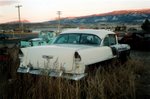
Remember, rust never sleeps!




On the way to work a few days ago, I was minding my own business in the right lane of a 4-lane divided highway. I became aware of a bright green late-model Ford Mustang (pre-2005 model) behind me in the left lane slowly catching up. Directly behind the Mustang was a Chevrolet Express cargo van from an electrical supply company. I noticed in my rear view mirror that the Mustang suddenly slowed down for no apparent reason. Then I saw the van whip into the right lane and cut off a BMW X5, whose driver flashed her high-beam headlights at the van.
Then as the van started to pass the Mustang on the right, the Mustang accelerated. I realized now that the Mustang driver had deliberately slammed on his brakes to frustrate the tailgating van driver. Now the two were in a race of sorts to get ahead of one another with me dead ahead in the right lane. Fortunately, the van backed off and passed me on the left behind the Mustang. Then after passing me, the van driver returned to the right lane and this time was able to go around the Mustang.
I caught up to the Mustang at the next red light. The car looked to be in immaculate condition with shiny aluminum wheels. The driver appeared to be around 50 or so, with a beard, and casually dressed. The kicker was the car's vanity plate. It read 1 NT2PSH, that is "one not to push!" So does this guy purposely "camp" in the left lane just to annoy drivers who get on his rear end?
 This beauty is a 1955 Chevrolet 210 2-door sedan in a pleasing two-tone combination of blue and white. The 210 was the middle trim line in the Chevy lineup for that year, between the top line Bel Air and low line 150. The car was a smash hit for Chevy, marking the first model year of the what came to be called the Tri-Chevys (1955-57 models) and some of the most coveted classic cars of all time. A V8 engine was optionally available for the first time starting in 1955, but I believe this car has the tried-and-true 6-cylinder engine. The car was spotted along Main Street in Highland Falls, New York, just across the street from the visitor center and museum of the US Military Academy at West Point.


