



On this leap day, I'm excited to announce I've made it: 602.1 miles on one tank of gas in my Toyota Camry! It was a little anxiety-provoking at the end, but success was achieved.
You see, there's this character in the Edmunds forums who thinks he's so smart (with PhD as part of his user name). Because his 2003 Camry 4-cylinder can only achieve 27-28 mpg on California highways, even when he keeps his speed below 65 mph, he's very skeptical of anyone who claims their Camry can get over 30 mpg, let alone near 40 mpg as some have asserted. His ultimate challenge: Make my day, go 600 miles on one tank (18.5 gallons) of gas.
My run was done on mostly all interstates on the way back from New Orleans, posted mainly at 70 mph, in my 2005 Camry 4-cylinder with a 5-speed automatic. This car gets lower mileage than my nearly identical 2004 Camry (the main difference is that the '04 has a 4-speed automatic). I put in 18.53 gallons when I filled up in Knoxville, Tennessee, the capacity of the tank. The car was tilted downward to the right at the station, and the pump nozzle was an "easy squeeze" type, making it easy to top up without risk of spillage.
So, my miles per gallon came to 32.5 -- typical for this car on highway trips, but the first time I risked running out of gas to see if I could make the magic 600-mile mark! Usually when I fill up, I end up putting in only 16 or so gallons at the most (550 miles driven), when the gauge reads exactly at the "E" mark, so I figured I could go another 50 miles. Note in the first photo that the gauge reads well below "E," and the yellow "low-fuel" warning light is illuminated.
By the way, my odometer reads 2.3% slow according to the highway mile markers, so if I correct for this factor, I actually went 615 miles.

Friday, February 29, 2008
It couldn't be done, he said...


Sunday, November 11, 2007
Get your kicks on Route 66!


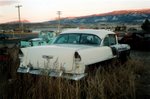
In the small town of Ash Fork, Arizona, a portion of historic US Route 66 still exits. Last spring during our trip through the southwestern US, my wife and I were traveling west on I-40, exited at milepost 146, and entered the old route that looped through the town. We immediately spotted these two old cars at a gas station. The one on the left is a 1957 Oldsmobile 4-door sedan and the other is a 1962 Buick Special 2-door sedan. Both are beyond redemption in terms of restoration, but they were still fascinating to behold. As is readily visible, cars rust differently in the arid Southwest, from the top down as the intense sun takes it toll on the paint. The sun also ravages the cars' interiors.
A little farther up the road, we came to DeSoto's Beauty and Barber Shop, complete with a 1960 DeSoto 2-door hardtop perched on the roof of what clearly had once been a service station (top photo). The last full model year for the DeSoto happened to be 1960; after a short production run of 1961 models, this storied nameplate passed into history.
We were about to re-enter the interstate at milepost 144 when we saw a sign directing us to an apparent continuation of historic Route 66 leading west out of town. Alas, after we traveled just a few hundred feet and rounded a curve, the crumbling remains of the road became visible, with a broken white line down the middle.  (The US switched to broken yellow lines in passing zones of 2-lane highways starting in 1972.) Needless to say, we had to turn around and get back on the interstate.
This minor diversion of maybe 20 minutes or so provided a wealth of memories (see post below for more about supposedly "wasted" time). Get your kicks indeed!
Friday, November 2, 2007
Time, time, time is on our side...


This has to be one of the most absurd arguments I've seen in the controversy over the setting and enforcement of speed limits:
I am continously astounded that no one seems to value time while everyone is concerned about lives. LIFE IS MEASURED IN TIME! What’s the use of saving one life if you have to waste a million man years to do it? At some point, the government has a responsibility for balance. If a million people a year waste an hour along a stretch of highway because the speed limit is too low, that’s tragic. We need a balance, yet we continuously only look at the “safety” side of the equation (from a commenter on The Truth About Cars about England's speed enforcement cameras).
This is sheer lunacy. I can think of a lot of other ways that one's time is "wasted" in the course of a day: waiting in line at the grocery store check-out counter, waiting in the doctor's office at 4 pm for your 3 pm appointment, or even "wasting" time by sleeping 8 hours when maybe you could "get by" on five. Or how about spending day after day at an unproductive, tedious job?
Besides, every state in the US other than Hawaii has maximum speed limits of 65 mph or higher on its rural interstates or equivalent roads (Hawaii's maximum is 60). In the Midwest and South, limits are typically 70 mph, and west of the Mississippi River, the majority of states allow 75 mph. Texas permits 80 mph, the highest in the nation, on over 500 miles of I-10 and I-20. If you can maintain 75 mph for 6 hours, stopping only 10 minutes every two hours for a break, you can travel 450 miles in a total of 6 1/2 hours. This isn't good enough?
From earlier entries on this blog, you can see I get a lot of enjoyment from traveling the slower back roads, where I've encountered amazing, beautiful, or quirky sights that would be completely missed by hustling along the interstates. Equating such time wasted with human life lost is, to use this commenter's words, "tragic."
Tuesday, October 30, 2007
Far from the madding crowd

Rural 2-lane roads are statistically much more dangerous than interstate highways. Still, with the constant traffic on so many US interstates including huge numbers of trucks and people in such a rush in their cars jockeying to get ahead of the pack, it can be a relief to take the older, quieter roads. It seems that the notion of "getting there is half the fun" has long been forgotten, and now everyone just wants to get there, wherever "there" is, in as little time as possible.
Meanwhile, on certain back roads at certain times, there is a solitude that simply can't be found on the interstates. This photo of the open road was taken last Sunday afternoon on US Route 340 just west of the Blue Ridge Mountains in the scenic Shenandoah Valley between the towns of Elkton and Waynesboro, Virginia. Oncoming traffic was light to moderate, I never had to pass a slower moving vehicle going my way, and no one approached my rear bumper for the entire 30-mile stretch.
Friday, October 19, 2007
Higher speed limits INCREASE safety?
 I couldn't believe my eyes when I came across the above op-ed headline (without the question mark and all caps) when I saw it in a copy of The Reflector, the student newspaper of Mississippi State University. The author, Lazarus Austin, was making the argument that in all cases where speed limits are raised in the US, highway deaths go down. He cited the myth of the German Autobahn, where death rates are supposedly lower than on US interstates, despite no limits on speed in most places. (This is no longer true, as more and more segments of the Autobahn do have posted limits.) He also stated that highway deaths increased when the speed limits across the US were lowered to 55 mph in 1974 following the Arab Oil Embargo. And he didn't fail to trot out the hoary falsehood that insurance companies support lower speed limits to rake in more profits. (After all, those speeding tickets give insurers an excuse to raise premiums.)
There was no way I was going to let this one go by, so I promptly fired off an e-mail to the author:
Mr. Austin,
After I read your editorial with incredulity, I was wondering if you attend Car and Driver College or the University of Motor Trend instead of Mississippi State University. What would you say to the following headlines, "Quitting Smoking Increases Cancer Risk," or "Condom Use Increases Chances of Getting HIV/AIDS?"
I'll have more to say in my blog about your blatant twisting of the facts regarding travel speeds and speed limits. In the meantime, I'd suggest you spend your time reading more authoritative material on highway safety rather than your favorite car enthusiast magazine.
__________________________
As it turned out, I didn't have to say anything more. Adrian Lund, Ph.D., the president of the Insurance Institute for Highway Safety, had sent this response to Mr. Austin, which was published in The Reflector:
It wasn't surprising to read that a young male driver finds speed limits inconvenient ["Higher speed limits increase safety," Oct. 16], but it's unfortunate that someone majoring in history would be so lax with the facts.
The author claims that higher speed limits have led to a decrease in the overall fatality rate. Basing such a claim on the overall death rate on all types of roads makes no sense. Many factors have pushed down the fatality rate over time including safer vehicles and increased safety belt use. Correlating speed limits on some highways to overall traffic death rates on all roads is like using national precipitation figures to measure rainfall amounts from Hurricane Katrina.
You have to look at the specific roads where the speed limits changed to measure the effect. Study after study shows more highway deaths when speed limits are raised.
Insurance Institute for Highway Safety research found 400 more deaths in 1989 alone on the roads where the speed limit was raised from 55 to 65 mph.
The author also is ignorant of the facts about the Autobahn. Research shows that from 1975 to 1986, before speed limits on rural interstates in this country began being raised from 55 to 65 mph, the death rate on the Autobahn was higher than on US interstates. Germany also has more stringent laws including a 50-mph speed limit for large trucks and a driving age of 18. Young male drivers have by far the highest crash rates, so perhaps the author would consider raising the driving age to keep the most dangerous drivers in the US off the road.
The bottom line is that safety is compromised, not enhanced, by higher speeds. There are plenty of opinions about speed limits. A discussion about raising them needs to be based on the facts.
Thursday, September 27, 2007
Speeding...or just going with the flow?
An interesting post came up in the forums on edmunds.com concerning gas prices. The poster was responding to an earlier comment from a Chicago area commuter who said he traveled at or slightly below the speed limit, mostly on 4-lane roads, on his drive to work. Others however drive like crazy only for him to catch up with them at the next red light -- the all-too-familiar "hurry up and wait" syndrome.
Here is the response to the commuter:
I'm not advocating that a person drive like a madman. I'm simply saying that if you drive at exactly the speed limit or a couple miles below on a road where traffic can't pass you then you are going to p___ people off. I've driven throughout most of this country and, for whatever reason, I've noticed that everywhere our speed limits are set artificially low. I've noticed that most people deal with this by driving around 6-9 mph over the limit, which is typically below what will put them at risk of a speeding ticket. Let's say the limit is 55 mph and you choose to drive 54 and have a bunch of people stacked up behind you that would otherwise be driving 63 mph. Would these people behind you really be saving all that much time? Probably not. Guess what, you're not saving all that much money [on gas].
My experience is the opposite of yours. I routinely drive a route that has a 12 mile stretch of road where it is almost impossible to pass. The posted limit is 50 mph but it is safe to travel considerably faster than that. Until a few years ago the predominant speed on this section of road was 60 mph, [but] it is now 50 mph. When you finally get to the end where there is room to pass you typically have 20+ drivers behind one guy that felt he was justified in imposing his will on everyone else.
I don't care if a person wants to drive slower to save a few bucks on gas. Just don't disrupt the flow of traffic.
I am especially amused by his saying, "for whatever reason, I've noticed that everywhere our speed limits are set artificially low." And my response would be, "in whose opinion?"
Well, I can tell you in Michigan that the speed limits aren't artificially low. Cars are allowed to go 70 mph on the metro Detroit freeways, and even major roads in the area with traffic lights like Telegraph Road have a 50 mph speed limit.
Most states west of the Mississippi have rural interstate speed limits of 75 mph for passenger vehicles. In Nevada, you can go 70 mph on the rural 2-lanes. On busy city streets in Los Angeles, the speed limit is 35. New Mexico allows 70 mph on undivided 4-lane US 550 (with conventional intersections even). The blanket speed limit in Manhattan is 30 mph. Certainly fast enough in all cases. I wonder if people driving on the parts of I-10 and I-20 in Texas that are now posted at 80 mph are complaining this speed limit is "artificially low" and bump it up to 86 to 89 mph.
If I'm "disrupting" someone's progress on a 2-lane road (one lane in each direction) by going the speed limit, my response is "too bad." However, I will encourage following drivers to pass me, if legal. If someone gets really obnoxious, like flashing his lights, flapping his arms, or getting so close I can't see his headlights, then I'll find a safe place to pull over. Or I wave them around in a legal passing zone. Funny thing, some of these people WON'T pass when you wave them around! Do they think I'm bluffing or somehow misleading them into a head-on crash?
Monday, September 24, 2007
Running with the big dogs
 This photo was taken on I-275 southbound near Detroit. Lots of tractor-trailers were present on this highway on a weekday evening. The top speed limit in Michigan for cars is 70 mph, surprisingly allowed even on this roadway in the Detroit suburbs. Michigan however has a lower maximum speed limit for trucks: 60 mph. Ohio and Indiana also have split speed limits on their rural interstates. I like this idea: Even though the trucks generally do go faster than their speed limit, they generally do not travel at 70 mph, which makes it easier for cars to get around the trucks. Also on highways with 3 or more lanes in the same direction, trucks are not allowed in the far left lane. The situation pictured above was a little dicey, because there was essentially no left shoulder, but rather only a high Jersey barrier dividing the opposing roadways. Still, we got through with no difficulties.
Tuesday, September 4, 2007
Portrait of an inconsiderate driver
 You can't see his face, but here he is, southbound on I-75 just south of
As you can see, he's driving a rusty old Toyota Corolla, not wearing a seat belt (typical), and holding the top of the steering wheel with one hand. Also, his seat back is so reclined that the head restraint would do no good in a rear-end crash. I guess he's going so fast though it's unlikely he'd be rear-ended at this point!
In case you are wondering, my wife took the photo from the passenger seat. And no, I wasn't holding up the traffic flow by going the speed limit. Large trucks in Ohio are limited to 55 mph on most Interstates. They may not go 55, but they do keep it under 65, the speed limit for cars. Most cars weren't going much faster than about 70 mph that evening.
Monday, March 19, 2007
Traveling (legally) at 75 mph and the rogue trucker

My wife and I took a vacation last week in the southwestern part of the US. We flew to Las Vegas, rented a car there, and drove through Utah, Arizona, New Mexico and back in a clockwise loop. This took us through various national parks, monuments, and historic sites such as Zion National Park, Navajo National Monument, Monument Valley, Canyon de Chelly, and Chaco Canyon.
We also stopped at Meteor Crater and the Lowell Observatory in Flagstaff. Most of our travels were on 2-lane highways, including historic Route 66 in Arizona, but we also used Interstates 15 and 40 in Nevada, Utah, and Arizona. Both roads mostly have 75 mph speed limits, applicable to all vehicles.
It was refreshing in a way to see the "natural order" restored, where cars travel faster than tractor-trailers, even while we maintained the speed limit. This was like the pre-55 mph days, when cars routinely passed trucks and not the other way around. It was so pleasant NOT to have truckers running up on your bumper before reluctantly moving over to pass.
In this same vein, it is interesting that the American Trucking Associations, along with several large trucking companies, have actually petitioned the federal government to mandate a top built-in speed of 68 mph for all newly manufactured tractors. Safety groups are quite pleased with this, saying that the "80-mph truck has no place on our highways." Of note, Texas recently raised the daytime speed limit to 80 mph for ALL vehicles on large portions of I-10 and I-20 in the western part of the state.
The independent truckers on the other hand are vehemently opposed to the petition, because for them, time saved means more money earned, safety notwithstanding. I apparently encountered one such trucker on westbound I-40 on the approach to Flagstaff. I had passed one tractor-trailer and was still in the left lane gaining on a second one, when literally out of the blue, this "rogue trucker" began to loom in my rear view mirror.
Well, 75 mph is fast enough for me, thank you very much, so I still had time to duck into the right lane behind the truck I was originally going to pass. The rogue whooshed by at maybe 90 mph and was soon gone.
That the government should accept the petition is a no-brainer to me.