

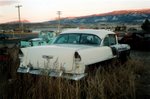


 Back on May 19, I posted an item about highway crash deaths that occurred near my residence. Another roadside memorial recently went up for the death of Gabriel ("Gabe") Ryan Dean on August 30, 2007. He was only 25 years old and died within a quarter mile of the location where Travis Fitzgerald, mentioned in my earlier post, lost his life. According to police, Dean apparently lost control of his Yamaha R1 motorcycle in a curve while traveling at what may have been a higher speed than recommended for the curve. The motorcycle struck the guardrail shown in the photo, and the helmeted rider was thrown off his bike. The tragedy is that more than 100 deaths, on average, occur every day on US roads. But has highway safety ever been mentioned by any of the 2008 presidential candidates? Not that I can recall -- John Edwards' pricey haircuts get more attention!
Saturday, October 20, 2007
Another crash death close to home


Tuesday, September 18, 2007
Highway safety...1950s style!
 This billboard was spotted along US Route 250 near Dennison in the eastern part of
The Haddon Matrix considers all factors before, during, and after a crash: human (the driver, cyclist, or pedestrian), vehicular, and environmental (the road and roadside). For example, daytime running lights added to a vehicle can make it more visible before a potential crash, reducing the possibility of a crash with another vehicle in the first place. During a crash, built-in safety features in the car such as airbags can greatly reduce the possibility of death or injury. And prompt response by trained paramedics after the crash can further improve the chances of survival and recovery. Today, we practice this much more balanced approach to highway safety. Sadly however, not all measures that we know to be effective, such as mandatory motorcycle helmet use laws, are in place because of political pressure.
Wednesday, August 22, 2007
Median crossover crashes a problem in Kansas
 I noticed a small news story in USA Today about a recent spate of deadly crossover crashes in
I've noticed that even on many Interstate highways that the typical grass median is not wide enough, in my view. For example,
Some states including the
Locally, there is one older freeway that raises eyebrows for me. It has a rather narrow level grassy median for most of its length, but on one half-mile segment that passes beneath a highway bridge and a railroad bridge, the median narrows down to a cement curb only about two feet wide. In this day of Jersey barriers (the ubiquitous curved concrete dividers where there is no space for a proper median), I am surprised that the state of
Thursday, July 12, 2007
Aloha! Hawaii reports record seat belt use

A recent article in the Honolulu Advertiser newspaper stated that seat belt use by front seat occupants had climbed to a record 97.6% in the Aloha State. This boggles my mind when I see so many people not using seat belts in central Virginia where I live. One important factor is that Hawaii has a so-called "primary" seat belt use law, where unbelted occupants can be cited directly by the police. Virginia by contrast has a so-called "secondary" law, where the car can be stopped only if some other violation, such as speeding, is first observed by a police officer.
Studies have shown that states with primary laws have greater belt use AND have fewer vehicle occupant deaths when population and other factors are taken into account. This is not surprising, because seat belts when used are very effective in saving lives in car crashes, and the unbelted tend to be the riskiest drivers and passengers. So getting these holdouts to wear belts brings the greatest benefits.
There is a rather interesting pattern as to whether a state has a primary or secondary law. Most of the coastal states (excluding New England) as well as the deep South, have primary laws. The plains and mountain states tend to have secondary laws, and the midwestern states are mixed. California, Oregon, Washington, and Hawaii all have use rates above 90%, the highest in the country. New Hampshire (the only state with no belt use law), the Dakotas, and West Virginia bring up the rear, with only about 50% belt use.
New England with its tradition of individualism has secondary belt use laws, except for Connecticut (primary) and of course New Hampshire (no law). Maine just recently adopted a primary law, slated to go into effect in September. Massachusetts and the upper New England states were among the last in the US to adopt mandatory belt use laws.
Thus, there isn't too much of a liberal vs. conservative pattern on seat belt laws with the "conservative" South having tougher laws than the "liberal" Northeast for example.
Saturday, June 30, 2007
A terrible way to die
Pulitzer-prize winning author David Halberstam was killed in a car crash in April in Menlo Park, California. He was being driven by a 26-year-old graduate student from the University of Berkeley when the student made a left turn in front of oncoming traffic. The older Toyota Camry the student was driving was struck on the right side of the passenger compartment where Mr. Halberstam, 73, was sitting. Halberstam died at the scene; the student suffered a punctured lung and the driver of the other car had only minor injuries.
Now the facts of the crash have been established. The crash occurred at the intersection of the Bayfront Expressway and Willow Road, just west of the Dumbarton Bridge across lower San Francisco Bay. The driver of the other car had a green light and was proceeding toward the bridge straight through the intersection. The graduate student, driving the opposite direction on the expressway, was facing two left turn lanes which had a red arrow, indicating of course that no left turn could legally be made at that moment. The student though was in the third lane from the left, a through lane coming from the bridge. Instead of going straight, however, the student made what possibly was a last-second left turn toward Willow Road, placing the Camry on a collision course with the oncoming late-model Infiniti, driven by a 64-year-old man.
From what I recall reading earlier, the graduate student had two prior driving convictions. He may have been a habitually careless driver, or perhaps he was so excited by the prospect of ferrying Mr. Halberstam that he wasn't paying enough attention to the driving task. Regardless, Mr. Halberstam had to pay a terrible price, and we as a society lost a gifted author who was still very much active. On the day of the crash, he was on his way to an interview for a book he was planning about the famous 1958 NFL championship football game between the New York Giants and Baltimore Colts.
There is a chance that the outcome might have been different if the Camry had been a 2002 or later model equipped with better side structure plus head- and chest-protecting side airbags. I have not seen photos of the damaged Camry to judge if such an outcome may have been possible.
The graduate student faces a charge of vehicular manslaughter, which carries a penalty of up to $1000 in fines and one year in jail. The Infiniti driver was not charged.
Wednesday, June 6, 2007
Live free or die...right?
New Hampshire is the only state in the US without a mandatory seat belt use law for adults riding in the front seats of cars. It's been the sole holdout for more than a decade. Even "macho" states like Texas, Wyoming, and Montana long have had mandatory belt use laws. Yet New Hampshire persists; after all the state motto "live free or die" appears on every NH license plate. Does this mean "live free" of belt use only to die by being ejected in a car crash?
For the first time since the 1800s, the Democrats took control of the state legislature after the elections of 2006. The New Hampshire House of Representatives narrowly passed a bill in April to require belt use. However, the bill was defeated by the Senate last week, failing on a vote of 16-8. Instead, the senators voted in favor of a measure to establish a "study commission" to consider ways to get more people to buckle up.
This seems a little silly in light of well-documented research that shows persuasion alone, such as "education" through public service ads, is ineffective in raising seat belt use. No, it seems the threat of a ticket by breaking the law is the most effective method, provided enforcement is well publicized and highly visible.
One enlightened senator, Democrat Peter Burling, countered the "nanny state" or "big brother" arguments against mandatory belt use by citing another important New Hampshire tradition -- that of the self-reliant community dealing with its own emergencies. He recalled a recent car crash in his district, "The social compact that binds us together kicked into gear," describing volunteers coming from all parts of the town to help. "You don't [buckle up], you're telling every one of those people, 'I don't care how much it hurts you to see me spattered across the road -- it's my individual liberty. And your job is to fix it.' "
I couldn't have said it better myself.
Monday, May 28, 2007
Corzine crash...the aftermath
"I'm New Jersey Governor Jon Corzine, and I should be dead," begins a new public service ad promoting seat belt use released ahead of the Memorial Day weekend. The governor was critically injured last month when his state trooper-driven SUV was clipped by a pickup truck on the Garden State Parkway. His SUV was traveling 91 mph in a 65 mph zone. Corzine wasn't wearing a seat belt and sustained fractures of his leg, collar bone, sternum, and 11 ribs. The trooper driving the SUV was wearing his belt and had minor injuries.
In the ad, Corzine states that he lost more than half of his blood, spent eight days in intensive care, and had to use a ventilator. He continues, "it took a remarkable team of doctors and a series of miracles to save my life when all I needed was a seat belt...I have to live with my mistake. You don't. Buckle up."
On your way home from Memorial Day activities today, remember his words. And control your speed. These can save your life!
Monday, May 21, 2007
Sudden death on the highway…so close to my home


These roadside memorials commemorate six deaths in four crashes that occurred very near my home. The first three memorials pictured stand on the side or median of a major 4-lane US highway within little more than a two-mile stretch. The last memorial is on a busy 2-lane state highway.
The one with the triple fatalities occurred on June 11, 1998. A 19-year-old University of Virginia student driving a Jeep Cherokee southbound in the right lane of the 4-lane highway was allegedly distracted by a bee that flew inside her vehicle. She swerved to the left just as a Chevy Monte Carlo was starting to pass her in the left lane.
Lois Deane, 49, driving the Monte Carlo, swerved to her left to avoid the Jeep, lost control in the median, rolled the car over and tumbled upside down into the oncoming lanes, where her car was hit by a Nissan Altima. Unfortunately, Lois had her granddaughters Renae and Cheyanne in the car, ages 10 and 4, who were completely unrestrained, ejected, and killed. Lois also was unbelted and killed. As I recall, there were two women in the Altima who were not seriously injured.
I saw photos of the Monte Carlo. The roof was crushed somewhat in the front, but the rear part of the roof was okay. There is no doubt in my mind that if the children had been properly restrained in the back seat, they would have survived, probably without serious injuries. I can't say for sure about Lois.
Ginger McCain, an employee of the University of Virginia School of Nursing, was killed on September 19, 2005. Her car was also southbound on this road and was nudged in the right rear by a Ford Focus that had edged out of an intersection from a stop sign. This occurred in heavy morning commuter traffic, and the Focus driver was probably trying to get moving into the fast-flowing traffic stream. Unfortunately, the Focus driver misjudged and Ginger’s Mitsubishi coupe was pushed off course so that her car went diagonally off the right side of the road at high speed directly into a large tree. I understand Ginger was wearing her seat belt, but the crash was too severe, and the car may not have had an airbag. However, her young daughter in a child seat in the rear was largely unharmed as I recall. Now, there is a traffic light at this intersection and a guardrail separates the roadway from the tree.
I do not know the circumstances behind Grace Kudro’s death, except that it occurred on September 19, 2006, exactly one year after that of Ginger McCain. The placement of the memorial suggests she was also southbound and went off the left edge of the highway and struck a tree in the median. She was only 23 years old and left behind two young daughters.
Travis Fitzgerald was 30 at the time of his death, which occurred on November 26, 2004, the day after Thanksgiving. He evidently died on a twisty two-lane road that carries a lot of commuter traffic. At night, deer can be commonly seen crossing the road, especially in the fall. The section on which he died has blind curves with advisory speeds of 35 mph, but hardly anyone slows down that much. The road itself until about a year ago had a posted speed limit of 55 mph (now 45 mph).
These were all tragic deaths. What can we learn from them? Always be alert, be cautious at busy intersections and blind curves, don’t swerve suddenly if you can help it, and above all, always wear your seat belts and make sure your child passengers are properly restrained.
Sunday, May 13, 2007
The human costs of car crashes

All too often, car crashes that kill or injure are regarded with a shrug by too many Americans. We regard crashes as the "cost" of motor vehicle travel or even blame victims for their deaths. In 2005, a total of 43,443 lives were lost on US highways, an average of 119 a day. I don't think we'd tolerate such a toll in any other area, such as plane crashes, food poisoning or tainting, US combat deaths in Iraq, or mass shootings like the horrible incident last month at Virginia Tech. Yet day after day, the killing continues on our highways, with none of the presidential campaigns, for example, even making the slightest mention of this issue. Think of it: something like school prayer gets more lip service -- the irony is that any school student can say a prayer in his/her mind at any time!
In the face of this apathy, the Insurance Institute for Highway Safety has issued a special issue of its newsletter Status Report that focuses on a single day in 2005: Tuesday, June 7, on which the "average" daily number of Americans perished for that year -- 119. The very real human tragedies behind the number are highlighted, with 60 of the victims named and 15 of their personal stories told.
As Adrian Lund, president of the Institute, puts it ("119 deaths in context"):
Researchers and advocates often measure highway safety progress in terms of deaths per population or mile driven, which have declined over decades. But progress has slowed in recent years. Total deaths have increased since a low of 39,250 in 1992.
This issue of Status Report reminds us of the real lives and tragedies behind the statistics. They remind us that, despite progress, crash deaths and injuries still are occurring in predictable ways. They aren't random or inevitable, and we aren't helpless to prevent them.
We should be encouraged by our past successes. Vehicles are more crashworthy than they used to be, and they're being equipped with technologies to prevent crashes in the first place. Laws addressing alcohol-impaired driving and other risky behavior have made a big difference, and roads are designed to be more forgiving when drivers make mistakes.
We need to apply this knowledge more widely. We need to evaluate new vehicle and road technologies that can help with traffic law enforcement. We need to do these things because we should do all that we're able to prevent crash deaths — and because we can.
You can read the entire issue by clicking on the link below.
IIHS Status Report special issue.
Some things that are very clear from these tragic stories include the following:
1. Always wear your seat belts, and make sure your fellow passengers do as well.
2. Always secure your children in age-appropriate child restraints and place them in rear seats.
3. Alcohol and driving are a deadly combination.
4. Control your speed. No matter what the enthusiast media state about speeding and speed limits, it's clear that excessive speed and recklessness lead all too often to death and injury. Today's cars may be more crashworthy, but their ability to protect their occupants is lost if impact speeds are equivalent to hitting a solid barrier at 45-50 mph.
5. Put down that cell phone and pay attention to your surroundings, especially the road in front of you.
6. Think twice about taking that marathon all-night drive to
7. Consider parking that motorcycle, but if you insist on using one, make sure you wear a helmet.
8. Bicyclists and pedestrians are no match for a couple of tons of steel -- watch for them and respect their space.
9. If you have teenage children drivers, make sure they follow the rules of the road and don't be hesitant about revoking their driving privileges at the first sign of problems. No parent should have to bury a child needlessly.
10. Remember that car crashes are not "accidents," as if they are random, unpredictable, or "acts of God." As Anne McCartt, senior vice president of the Institute puts it, "... if you look closely at the deaths on June 7, you see that none of the people in these stories had to die. We know how to prevent most crash deaths. We just don't always apply what we know."
Thursday, April 19, 2007
Corzine crash revisited
More has now been revealed in New Jersey about last week's vehicle crash involving Governor Corzine. The onboard event data recorder ("black box") determined his SUV was traveling 91 mph just before the crash.
The other drivers were just trying to get out of the way when the collision occurred between Corzine's SUV and a pickup truck, with the Suburban then going to the left and hitting a guardrail at 30 mph, again according to the EDR. Corzine wasn't belted and was severely injured. He's lucky to be alive. The state trooper driving the SUV was belted and sustained only minor injuries.
And what was the "emergency" that caused the furious pace (26 mph over the speed limit)? They were rushing to the governor's mansion for a meeting between Don Imus and the Rutger's women's basketball team!
Friday, April 13, 2007
Governor Corzine caught not using seat belt
While I sincerely hope that Governor Jon Corzine of New Jersey fully recovers from the injuries suffered yesterday evening as a result of a vehicle crash on the Garden State Parkway, I can't believe he wasn't wearing a seat belt while riding in the right front seat of his state-trooper driven Chevy Suburban:
Eyewitness News -- Channel 7, New York
(New York - WABC, April 13, 2007) - Officials say New Jersey Governor Jon Corzine was apparently not wearing a seat belt when his SUV crashed on the Garden State Parkway Thursday night.
I mean, he's not a gun-totin' ''live free or die" right-wing rugged individualist as far as I know. Does he expect his state police escort to magically part traffic like the Red Sea so his car will never hit another one? If anything, he certainly sets a poor example when seat belt use has been mandatory in his state since 1985 (and is now the law in all other states except New Hampshire). I can only hope he learns something from this incident.